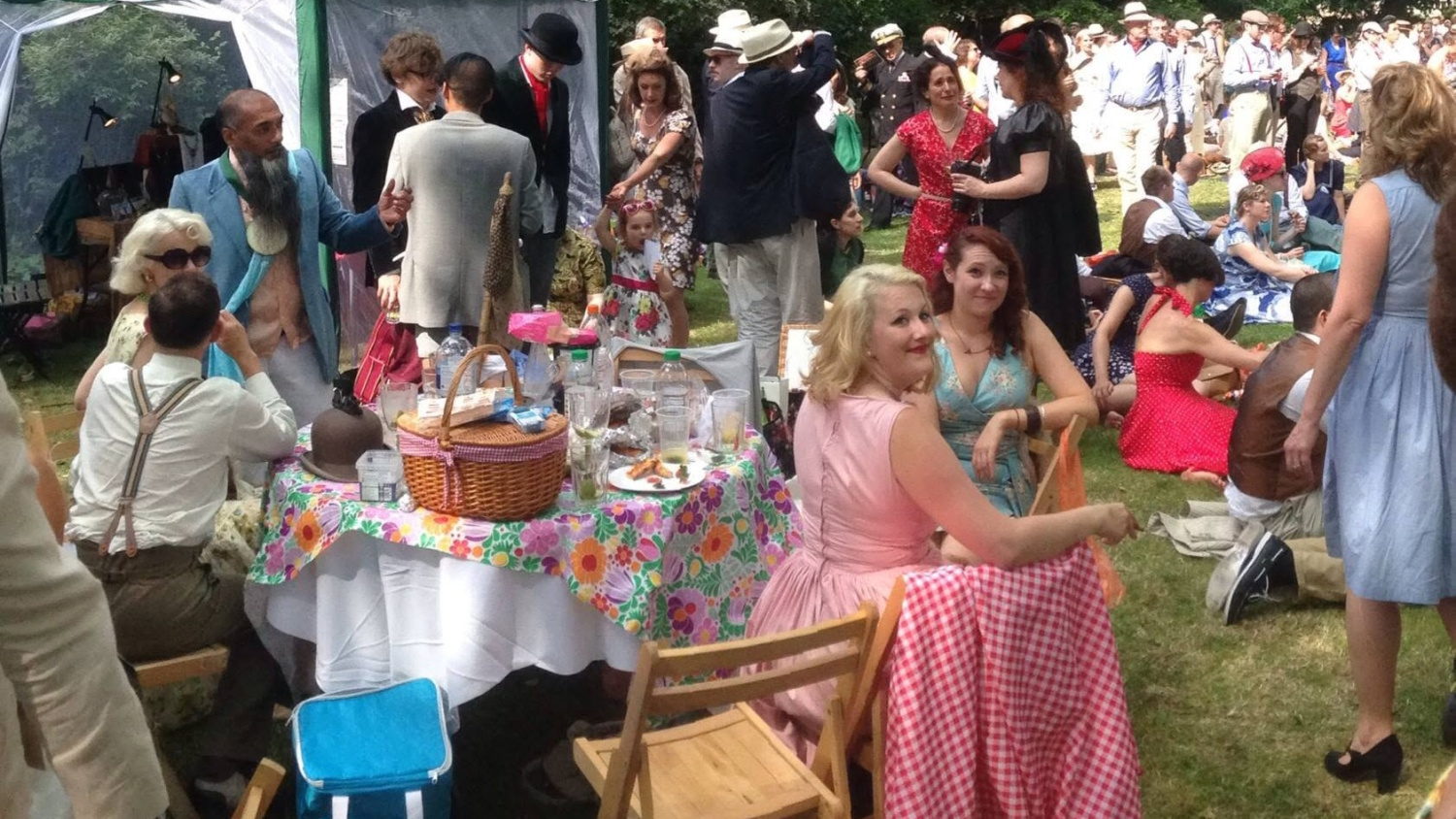
It is a truth insufficiently acknowledged that the Eccentric Club, for all its antiquity and address, does not hold the monopoly on English oddity. Step out of an evening and one finds the capital thick with kindred spirits: men in thornproof tweed pedalling towards no fixed destination, women in tea dresses raising illicit cocktails in candlelit cellars, whole regiments of the impeccably overdressed marching upon the streets of St James's for no reason they could name under oath. London, it turns out, is riddled with our cousins. What follows is a partial map of the territory — a brief survey of the societies, revels and repositories that carry the torch for a more elegant, more absurd, altogether more civilised way of going about things.
A distinction is worth drawing at the outset. Many a Londoner will pull on a flapper dress or a wing collar once a year, endure a themed party and be back in athleisure by Monday morning. But many men and women in this article are of another order altogether: they have adapted their whole lives to an alternative-attire existence — dressing, dining and disporting themselves as though the present century were an unfortunate rumour.
They are, in the truest sense, time travellers who have elected to live among us, and it is their world, not the weekend dabbler's, that the following survey sets out to chart.
The flaneurs and their doyen
No account of the modern eccentric may begin anywhere but with The Chap. Founded in 1999 by Gustav Temple and Vic Darkwood, the little periodical spent a quarter of a century urging Englishmen to reject the vulgarity of the age and return to tweed, courtesy and a decent Windsor knot. In 2025 the print edition finally laid down its pen, though not its cause: The Chap has reincarnated itself as a members' club, dispensing online despatches, annual volumes and a busy calendar of public mischief. Temple remains its presiding spirit and, arguably, the doyen of the whole dandiacal revival — and, our own records show, an Hon Eccentric Club member himself.
The club's most beguiling invention is the Grand Flaneur Walk, a saunter sans purpose held each May beneath the statue of Beau Brummell on Jermyn Street. The sixth of these took place this year on Sunday 17th May, and the conceit could not be simpler nor more subversive: the participants set forth with no route, no timetable and no destination, walking until somebody declares that they have arrived. In a century of buzzing devices and shouted enquiries of "Where are you?", to wander with genuine aimlessness has become a lost art, and the flaneurs, quaintrelles and boulevardiers who gather at Brummell's feet are its last practitioners. So popular did the ritual prove that the dandies now venture out in winter too; the inaugural Grand Flaneur Winter Walk braved November's skies in 2025 and, by all accounts, the cold did nothing to dampen the tailoring.
To wander with genuine aimlessness has become a lost art.
Then there is the Chap Olympiad, that Tournament of Tomfoolery in which competitors vie at Umbrella Jousting, Not-Tennis and the hurling of bowler hats towards distant hat-stands, sporting prowess being valued rather less than the correct cravat. Having run for fifteen summers in London's Bedford Square Gardens before falling silent in 2019, the Olympiad returned in triumph — a full-dress revival in November 2025 tied to the publication of a commemorative volume, followed this summer by a full restoration on Saturday 18th July, mere days before these words were set down. Tellingly, it forsook its old Bloomsbury base for Grange Gardens in Lewes, the Sussex town Temple calls home — proof that the Chap's centre of gravity has drifted south with its founder. A further outing is promised at the Goodwood Revival in September, amid the roar of vintage Maseratis. One suspects Brummell would have approved of the venue, if not the petrol.
Behind much of this stands the figure of the modern dandy — not the peacock of the runway but the everyday aesthete who dresses, as one chronicler had it, in mischievous defiance of the tracksuit. His spiritual home remains St James's, where Jermyn Street's shirtmakers will still stitch a concealed snuff pocket into a collar without so much as a raised brow, and his patron saint is Brummell, who reputedly required five hours to dress and elevated the plain, perfect suit into a weapon against dullness. That the world's foremost museums have lately turned their gaze upon dandyism only confirms what our set has always maintained: that how a man attires himself is never merely a matter of cloth.
No dandy's armoury is complete without the moustache, and London keeps a whole society devoted to it. The Handlebar Club — the oldest whisker club in existence — was founded in April 1947 in the dressing room of the comedian Jimmy Edwards at the Windmill Theatre, and admits only those who can furnish 'a hirsute appendage of the upper lip with graspable extremities'; beards are strictly forbidden. Its members meet on the first Friday of each month at a Paddington pub for fellowship and charitable good works, and they declare themselves at war with a world that demands 'the bland, the boring and the generic'. That a club barring beards should have staged the World Beard and Moustache Championships is the sort of contradiction the English manage better than anyone: in 2007 the Handlebars brought the biennial contest to the Brighton Centre, where some two hundred and fifty competitors across seventeen categories were judged by Nick Cave and Billy Childish before a sell-out hall, and twelve and a half thousand pounds went to charity. Presiding as master of ceremonies was Michael 'Atters' Attree, an editor of The Chap and another name upon our own membership roll — this world, as ever, closing upon itself. It is, in miniature, the whole creed of the eccentric persuasion, waxed to a fine point.
London on two wheels
If the flaneur perfects the art of the stroll, the Tweed Run perfects that of the pedal. Established in 2009 as a modest jaunt of a few hundred riders, this metropolitan bicycle ride "with a bit of style" has swelled into a rolling fashion parade of nearly a thousand souls, wheeling past Big Ben and Birdcage Walk in plus-fours, faux-fur collars, golfing socks and the occasional penny-farthing. This year's edition ran on Saturday 18th April; next year's is already fixed for 17th April 2027.
The rules are gloriously the wrong way round. There is no prize for finishing first — the twelve-mile route is deliberately gentle, with a halt for tea and a picnic and a cocktail waiting in a walled garden at the close — but there are laurels aplenty for the finest moustache, the best-dressed rider and the most elegantly adorned machine. It is, as more than one wag has observed, the precise sartorial opposite of the World Naked Bike Ride, and the terror of appearing underdressed keeps standards heroically high. The event has spawned imitators in New York, Tokyo and Paris, yet the London original remains the one the world flies in to attend.
The Tweed Run is not the only excuse to mount a high-wheeler. The penny-farthing — that perilous Victorian contraption of one towering wheel and one tiny — has its own devoted following in the Penny Farthing Club, founded in 2013 by the adventurer Neil Laughton. Its members school novices on the public roads of London, stage Victorian-costume rides, and pursue the club's improbable speciality of penny-farthing polo, contested by teams from England, Scotland and Wales; at Herne Hill Velodrome and the Lee Valley VeloPark they have lately built record-breaking 'stacks' of well over a hundred riders balanced side by side. It is, quite literally, eccentricity at altitude.
The Jazz Age, revived by candlelight
For the eccentric who prefers his revels after dark, the presiding genius is Clayton Hartley. A lifelong devotee of the 1920s and '30s who dresses the part more or less permanently, Hartley wears two crowns. By day, or rather by ceremony, he is Club Secretary of the New Sheridan Club, that self-described refuge for "languid fops and consumptive aesthetes" who favour worsted over hoodies; by night he is the founder of the Candlelight Club, London's peerless recreation of a Prohibition-era speakeasy.
The Candlelight Club began, fittingly, at a New Sheridan gathering in the summer of 2010, when Hartley fell into conversation with an American of hospitable inclinations lately returned from New York's speakeasy revival. The result, now fifteen years old and celebrated as such last autumn, is a travelling cocktail den lit entirely by hundreds of candles, its location kept from ticket-holders until a couple of days beforehand. Within, guests in Jazz Age finery sip vintage recipes, dance to live bands and submit to the barbs of a resident compère while the whole clandestine affair flickers like a scene from The Great Gatsby rendered in a Hackney warehouse. From this single conceit Hartley has conjured variations over the years: the Excelsior Club, a plusher counterpart modelled on the haunts of the high-rolling bootleggers who dined with the police chiefs, and not seen for a decade now; Herr Kettner's Kabaret, a Weimar-tinged cabaret staged with Kettner's in Soho and presently in abeyance; and Mrs Peel's, a foray forwards into the psychedelic optimism of the Swinging Sixties, got up with Count Indigo.
The revival is not Hartley's alone. Working the same after-dark territory, but at a more commercial pitch, is the Black Cat Cabaret — London's self-described 'original cabaret trouble-makers', who since 2014 have conjured the giddy spirit of belle époque Paris in a run of sumptuous variety shows, from Salon des Artistes to Hotel Black Cat and Bohemia. Staged over the years at the old Café de Paris, at Crazy Coqs and now at their Soho home in the Underbelly Boulevard, their evenings send aerialists, contortionists, drag turns and elegant burlesque tumbling one after another beneath the eye of a razor-tongued master of ceremonies. Where Clayton deals in intimacy and shadow, the Black Cat deals in feathers, sequins and footlights — the same disreputable glamour, played at full theatrical volume.
The New Sheridan Club itself deserves a bow. Beyond furnishing Hartley to the wider world, it convenes on the first Wednesday of each month at the Bishop's Finger, overlooking Smithfield Market — its home since the old Wheatsheaf in Rathbone Place, Fitzrovia, where it had held court for twenty years, closed its doors in 2025 — for lectures on subjects arcane and improving; and it hosts a splendid film club at the Tea House Theatre in Vauxhall, where the bill runs to Chappist comedies and forgotten matinée idols. The Tea House is a period piece in its own right: a Victorian public house of 1886, raised on the site of the old Vauxhall Pleasure Gardens — the very "Vanity Fair" of Thackeray's novel — which trades as a café by day and a theatre by night, pours some of the finest loose-leaf teas in London and, as a point of principle, declines to sell coffee at all. Its house motto, apt for this set, is a promise that it will not hurry you.
Nor is the Club's life confined to town. Each spring, on or about St George's Day, its members decamp to Oxford for the Annual Picnic, Punt and Plunge — hiring a flotilla of punts at Magdalen Bridge, poling upriver to a meadow for a shared repast, and running a sweepstake on which of their number will topple into the Cherwell (each participant draws a secret number, the better to discourage anyone from improving the odds with a well-timed shove). They drift between the Candlelight Club and, while it ran, the Excelsior as naturally as they drift between the pages of a Waugh novel.
The impresarios of Prohibition
Bourne & Hollingsworth (B&H) worked on an altogether larger scale. Since opening their first bar in 2007, the group assembled a small empire of themed revelry, and no roll-call of eccentric London could omit it.
Chief among their creations was the Blitz Party, billed as the city's most authentic 1940s knees-up, which transformed raw railway arches and cavernous vaults into wartime air-raid shelters — sandbags, blackout curtains, ration books in place of menus, victory curls and Home Guard uniforms swaying to a live swing band. The devotion to detail was such that guests half expected a siren.
The group has since put down roots. Alongside the original Fitzrovia cocktail bar of 2007 and the Shoreditch outpost Reverend JW Simpson, it now keeps a permanent clubhouse in Clerkenwell: Bourne & Hollingsworth Buildings, just off Exmouth Market, where a brasserie set inside a greenhouse of trees and trailing creepers gives on to a cocktail bar, a cookery school, private rooms and a subterranean dancing den. The promoters of the one-night pop-up have become landlords, which is either the reward of persistence or its price, depending on one's view of these things.
The same house was responsible for the Prohibition Party — London's longest-running 1920s immersive event, staged over the years in palatial ballrooms and, on at least one occasion, aboard a steamer moored on the Thames; the Dark Circus Party, a big-top spectacle; and SS Atlantica, a maiden voyage aboard an imaginary ocean liner. They have partnered with the Tweed Run, and for many years lent their considerable logistics to the expansion of the Chap Olympiad.
The cabinet of wonders
For eccentricity of an altogether stranger key, one must repair to Mare Street and the Viktor Wynd Museum of Curiosities, Fine Art & UnNatural History — the physical seat of the Last Tuesday Society, a 'pataphysical organisation claiming descent from a circle founded by William James at Harvard in the 1870s.' Wynd — the Society's self-styled Chancellor and, as our records show, Eccentric Club member No.0025 — has assembled a Wunderkabinett that makes no attempt at order or instruction: two-headed kittens and dodo bones share shelf-space with McDonald's Happy Meal toys, occultists' paintings, celebrity ephemera and objects too disreputable to describe in a family periodical. The museum's stated aim, so far as it admits one, is the theft of its visitors' time and the provision of amusement by return.
Beneath the collection lurks the award-winning Absinthe Parlour, a bar whose rotating cocktails take their cue from the macabre surroundings, and above it a relentless programme of lectures — on death masks, the Golden Dawn, witchcraft in Gothic cinema, the inner lives of fish — delivered in person and beamed out by Zoom to the faithful worldwide. Not content with a Hackney basement, Wynd also leads collecting expeditions to the far corners of the earth, from the Sepik River of Papua New Guinea to the cradle of Vodun in West Africa. It is, in short, the most disreputable and delightful museum in London, and precisely the sort of institution the phrase "cabinet of curiosities" was coined to describe.
Wynd's reach extends well beyond Mare Street. In earlier years he was closely bound up with the Academy of Arts and Sciences, the Notting Hill salon of the late Martin Miller — gin magnate, antiques-guide man and one of our own, whom this magazine has already had cause to mourn — an institution that did not outlive its founder; he has taught the anthropomorphic art of mouse taxidermy through his own British Academy of Taxidermy; and
across four summers in the early 2010s his boutique 'anti-festival', Wyndstock, decamped with his colleague Mark Holdstock to the Palladian splendour of Houghton Hall in Norfolk, by kind permission of Lord Cholmondeley, for croquet on the lawn, literary talks, a candlelit dinner and a secret bar deep in the woods.
It fell victim to its own success: the last of them drew some fifteen hundred guests, which its founder reckoned about a thousand too many. Add to these his masquerades, his séances and 'Loss — an Evening of Exquisite Misery', at which guests dress in decaying finery and chop onions until they weep, and one has a repertoire no sane impresario would attempt.
Nor was Miller's the only such academy Notting Hill has nurtured. A few streets away, and to much the same civilised end, Tom Hodgkinson and Victoria Hull opened the Idler Academy in 2011 — the bricks-and-mortar offshoot of the Idler, the magazine Hodgkinson had founded in 1993 under the Johnsonian banner 'literature for loafers'. Part bookshop, part coffee-house, part classroom, it taught its neighbours philosophy, Latin, calligraphy, grammar and the ukulele, on the principle that a life is better furnished with useless accomplishments than with none. The shopfront closed in 2015, but the Idler has proved hardier than most: it endures in print, in a busy roster of online courses, and in the Idler Festival, which each July takes over Fenton House and its gardens in Hampstead for a weekend of talks, philosophy and merriment, still preaching idleness and the classical arts to anyone minded to step off the treadmill. Of all the enterprises gathered here, it is perhaps the one that puts the whole argument most plainly.
The queen of the peripatetic party
The Last Tuesday Society owes much of its early lustre to Suzette Field, who joined the fledgling organisation in 2007 and, alongside Wynd, spent the better part of a decade astonishing London with lavish, literary and thoroughly atmospheric happenings. The two have since gone their separate ways, and Field went on to found A Curious Invitation, an arts-events company of her own devising that scattered parties, lectures and workshops across the city in the same erudite vein: masked balls for thousands, talks staged with the National Trust, and — the most durable of her inventions — London Month of the Dead, a season of morbid enquiry conducted each October among the tombs of the Magnificent Seven cemeteries. The great balls appear to have had their day, and the company's own listings stand empty as these words are set down; but the Month of the Dead ran its full course last autumn, over sixty talks, tours and torchlit concerts, and its season is not yet upon us.
Suzette's career began in 2000 with the Modern Times Club, a retro cabaret night that Tatler christened "the Rolls Royce of cabaret" and that launched the Puppini Sisters and Paloma Faith upon an unsuspecting public. Her book — A Curious Invitation: The Forty Greatest Parties in Fiction — casts a professional eye over the finest revels in literature, from Trimalchio's feast to Gatsby's lawn, and reads rather like a manifesto for everything she stages in the flesh.
The ball and the scaffold
The impulse to dress up and step back in time finds two further outlets beyond the speakeasy, and they could hardly be less alike. The first is the ball. South of the river in Crofton Park, the Rivoli Ballroom — the capital's last intact 1950s dance hall, all crimson velvet, gilt and a sprung maple floor — plays host to a rolling calendar of period nights: swing evenings, jive sessions, northern-soul all-nighters and the occasional Grand Vintage Ball with a best-dressed pageant attached. Feeding it is a flourishing swing-dance revival, in which Swing Patrol runs classes and socials across town, the Saturday Night Swing Club gathers monthly, and the annual Spring Swing Ball asks its guests to turn out as though bound for the Savoy Ballroom of the Jazz Age. For anyone who takes their tailoring seriously, these are the rooms in which to prove it.
Statelier and more formal by far was the Russian Summer Ball, founded in 1996 by Alexander Suscenko and the capital's Russian émigré community as a living echo of the Imperial balls swept away by the Revolution. For the better part of thirty years it filled the state rooms of Lancaster House and Carlton House Terrace each June with tiaras, sashes and Romanov princes — a spectacle Tolstoy might have recognised, the only difference, its founder liked to say, being that it took place outside Russia. Of late the ball has lapsed, though rumours of a revival persist among those who recall its magnificence.
The second outlet is stranger, and a great deal more solemn. On the last Sunday of January each year, several hundred men and women in the dress of Charles I's Royalist army assemble on the Mall and process — to the beat of muffled drums and with colours flying — along the King's final route from St James's Palace to the Banqueting House on Whitehall, where in 1649 he was beheaded. This is the King's Army of the English Civil War Society, whose 2026 muster was its fifty-fourth; the wreath they lay marks the spot of what they pointedly decline to call an execution, preferring the phrase "His Majestie's horrid murder".
It is perhaps the most poignant fancy dress in London: a piece of living history staged, every winter, in deadly earnest.
Nor does the capital hold the monopoly, for the Home Counties keep at least one fixture worth the train fare. In Buckinghamshire, Wyrd Wycombe has conjured an entire folk festival out of a half-forgotten local legend: the Wycombe Wyrm, a dragon said to have troubled the valley in some unrecorded century, exhumed from the archives and set loose again upon the town. The first of them fell on 1st February, the feast of St Brigid and the old quarter-day of Imbolc, and offered a folk-horror art exhibition, newly composed songs, dancing, the New Moon Morris and — as its centrepiece —
a knight in full plate doing battle with a fifteen-foot wyrm.
A second is already being raised for 2027 by way of a bucket, some pin badges and the goodwill of the neighbourhood.
The moving force is Stevyn Colgan: Cornishman, thirty years a Metropolitan police officer, afterwards a researcher and scriptwriter for QI and The Museum of Curiosity, latterly an artist, author and folklorist — and, as these pages may record with some proprietorial pride, the Eccentric Club's own Greatest British Eccentric of 2025. His creed is that folk culture 'demands nothing': that a pageant asks no credential of anyone who joins it, and that in an age busily driving people apart, a town inventing a dragon together is not the least useful thing that might be done. He keeps a second Buckinghamshire date too, co-staging a midsummer gathering at West Wycombe on behalf of the Dashwood family — bonfire, Morris and tours of the caves in which Sir Francis Dashwood's Hellfire Club conducted its notorious business in the 1700s. That the ancestral seat of English club-going mischief should now host a solstice party is a piece of continuity almost too neat to credit.
Thus far, the eccentric at large — the clubs one joins, the parties one turns out for, the streets one processes down of a winter Sunday. But English oddity keeps an older and more sedentary side too: a world less of events than of types, of institutions and houses, in which the same refusal of the ordinary is pursued behind heavy curtains rather than paraded down the Mall. To that indoor cousin we now turn.
The Young Fogey
Before the flaneur pedalled off on his sit-up-and-beg bicycle, there was the Young Fogey — and no survey of English oddity may skip him, for he is the ancestor of the entire tweed-and-Waugh persuasion.
The type was christened, or at least given flesh, by the political columnist Alan Watkins in a Spectator Diary of 19th May 1984. Watkins, characteristically, disclaimed all credit: he had borrowed the phrase from the Proust translator Terence Kilmartin, who had applied it to the Cambridge don John Casey, and traced it further back to the novelist Dornford Yates in 1928. But it was Watkins who drew the portrait.
His Young Fogey was "libertarian but not liberal", a scholar of Evelyn Waugh, coolly religious in either the Roman or the Anglican key, an enemy of modern architecture and a stickler for the old Prayer Book, for grammar, syntax and punctuation. He was conservative yet had no time for Mrs Thatcher. He preferred the Telegraph to the Times, which he considered fallen. He walked, or took the train; foreign holidays were not for him.
So instantly did the caricature take hold that within a year it had a handbook. Watkins declined an invitation to write The Official Young Fogey Handbook, but the Fleet Street journalist Suzanne Lowry stepped in, and The Young Fogey Handbook: A Guide to Backward Mobility duly appeared from Javelin Books in 1985 — a slim, satirical field guide to a breed said to be emerging, from Bath to Balmoral, into the light. It taught the reader to distinguish the true article, in his fusty tweeds and hefty brown brogues, from the slick imitator; it recorded his four cheers for Waugh, Betjeman and Disraeli and his loathing of the Church Commissioners and modern building; and it pondered, straight-faced, the Great Young Fogey Mystery of whether the female of the species existed at all. The archetypes named at the time were the novelist A. N. Wilson and Dr Casey of Gonville and Caius, with Charles Moore and Simon Heffer close behind.
There were forces at his back. Granada's 1981 dramatisation of Brideshead Revisited had detonated slowly across the decade, and the "Brideshead look" — the four-piece suit, the antique dinner jacket, the decanter of port in undergraduate rooms — furnished a whole generation of Oxford men with a costume and a creed. By 2003 the writer Harry Mount could publish an elegy in the same magazine that bore the Fogey, declaring him extinct, gone off into the sunset with his fedora and his wicker basket. Yet the obituary proved premature: commentators have lately proclaimed his return, marking forty years since the Handbook and detecting, among the young, a fresh appetite for tweed, liturgy and correct punctuation.
The flaneurs of the Grand Flaneur Walk are, in a sense, his heirs — the Fogey grown convivial, and out for a stroll.
Quite what he looks like now is a matter of some dispute. The Spectator's own anniversary reckoning proposed a successor and furnished him with a name: the Trad Lad, who favours a plain navy two-piece over four pieces of heavy tweed, hunts second-hand Aquascutum where his forebear hunted Laura Ashley, and makes his pilgrimage to Sir John Soane's Museum along the Elizabeth line. The push-bike has gone the way of all unattended property in London, so he settles for a hire bicycle — which at least has a basket. He drinks Ovaltine, takes a hot water bottle to bed, keeps up with the Spectator, dips into the Idler and is increasingly curious about The Chap. The lineage, in other words, runs directly into everything described here.
He has no clubhouse, however, and appears to want none. An early attempt at incorporation, the Young Fogeys of Oxford, was run from an undergraduate's rooms at Balliol around 2011 and went the way of most student societies. What stands in its place is the Young Fogeys Club, some six thousand strong and, by and large, exactly what it appears to be: a Facebook group. Its members convene on a screen, admire one another's tailoring, and then disperse to the events that other people have gone to the trouble of organising — the Tweed Run, the Grand Flaneur Walk, the Olympiad at Lewes, the Eccentric Club dinner. It is a telling arrangement, and an oddly faithful one.
The Fogey began as a type rather than a society, and a type he remains: a diaspora rather than a membership, turning out in numbers at everybody else's parties and troubling to hold none of his own.
The endangered oddities
Not every eccentric institution thrives. Some cling on by their fingernails, and around others one can almost hear a ghost — for the appetite for organised whimsy, so robust a century ago, has thinned considerably, and the buildings that house it are forever one rent review away from oblivion.
Consider the strange afterlife of the Sette of Odd Volumes, founded in London in 1878 by the antiquarian bookseller Bernard Quaritch and devoted, by its own account, to "conviviality and mutual admiration". This was a bibliophiles' dining society without a clubhouse: a monthly excuse for a good dinner, at which members — each of them an Odd Volume, presided over by His Oddship — read papers to one another and printed them afterwards as exquisite little opuscula, marked "To be Had of No Bookseller" and circulated among the initiated alone. Its guests over the years ran from Oscar Wilde and Bernard Shaw to Bram Stoker, Richard Burton and Aubrey Beardsley; its ranks, by the century's end, harboured occultists of the Golden Dawn; and its presidential chair is said to reside to this day at the Savile Club. Whether the Sette itself endures is a nicer question. The Oxford Companion to the Book holds that it survives yet, a small society still given to book collecting and fine printing; the Times Literary Supplement counters that its unbroken life ran out around the Second World War. Either way, the great Victorian pomp is spent, and what remains — if anything remains — is a flicker of the old flame rather than the blaze.
The Horse Hospital, by contrast, is a survivor of the most bloody-minded kind. Its premises are the genuine article: a Grade II-listed block of stables raised in 1797 by the developer James Burton, on the cobbled corner of Colonnade in Bloomsbury, to nurse the sick cab-horses of the neighbourhood — the ramps up which the animals were led still bear their anti-slip ridges. Since 1993 the building has served an altogether different constituency. Founded the year before by the stylist and costume designer Roger K. Burton, and opened with Vive Le Punk! — a retrospective of Vivienne Westwood and Malcolm McLaren — it is reckoned London's longest-running truly independent arts venue, a temple to counterculture, outsider art, experimental cinema and the wilfully unfashionable. In its vaults lives the Contemporary Wardrobe Collection, an archive of some twenty thousand garments of post-war street and youth fashion that has dressed everything from Quadrophenia to museum vitrines, and which pays the venue's bills. That it exists at all in 2026 is a minor miracle: when its landlord moved to lift the rent from around thirty thousand pounds to over a hundred thousand, and later pressed for steeper rises still, only public outcry and crowdfunding kept the bailiffs from the door. In 2025 the founder handed the reins to the Horse Hospital Collective, charged with carrying the do-it-yourself vision onwards. Against every actuarial expectation, the old infirmary is still crouched on its corner, still flickering with film.
Houses of secrets
Older eccentricity, and larger in scale, is to be found not in Mayfair but on Portman Square, where Home House occupies three Georgian townhouses raised in the 1770s for Elizabeth, Countess of Home — a rich, twice-widowed grande dame nicknamed the Queen of Hell — and fitted out by Robert Adam with a painted staircase and glass dome that survive intact. In the twentieth century the house passed to the Courtauld Institute, whose director for a quarter of a century was the art historian and Soviet agent Anthony Blunt; here, on the top floor, the Cambridge spies are reputed to have mingled with the very Establishment they were busy betraying.
Restored and reopened to members in 1998, Home House trades still on precisely this air of glamorous misrule, advertising that it keeps no rules whatsoever — save one: nudity is discouraged.
It is also the salon of the writer and self-styled British dandy Robin Dutt, who for years has convened his Poetry Salon, his creative-writing circle and his book club within these walls, and whose sumptuous limited-edition study Dandemonium — The Dandy Defined sets out to rescue the breed from the lazy charge of mere peacockery. The house remains, in short, a working shrine to the well-dressed mind.
A short walk east, on Portland Place, stands another Adam mansion with a livelier afterlife. No.33 — a stately Marylebone pile of the 1770s that once served as the embassy of Sierra Leone — became, in the 2000s, one of London's most storied party houses and a favourite of film crews and photographers: the main hall stood in for royal chambers in The King's Speech, Amy Winehouse filmed "Rehab" within its walls, and Kate Moss posed there. Its proprietor was Edward Davenport, the self-styled "Lord" and showman known to the tabloids as Fast Eddie, whose gatherings drew a raffish, bohemian crowd until a fraud conviction in 2011 obliged him to sell the house four years later. Undeterred, he decamped across the road to No.32, where he continues to stage exhibitions and events to this day. Chief among them is Portland Art, a series of deliberately underground gatherings built around the salon of the artist Philip Firsov, whose most devoted regular is O.B.W. (featured in our magazine) — never knowingly absent from a Firsov evening, and one of those thoroughgoing originals for whom period dress is not a costume for the night but the fabric of a whole life. It is the Portland Place tradition of the private happening carried on, in a key more notorious than genteel. It is not, perhaps, an address the fastidious flaneur would advertise; but
Eccentricity has never confined itself to respectable postcodes.
Not everyone drawn to this world is quite as they first appear. The author Tyne O'Connell — a self-styled Mayfair eccentric given to wearing a tiara about town, and by her own account a goddaughter of Quentin Crisp — was named the Eccentric Club's Most Eccentric Thinker of the Year in 2015 before parting company with it. Her attempt to convene a circle of her own survives in a scattering of gatherings — an odd game of croquet, a soirée at Home House, tea and dessert at The Wolseley on Piccadilly. She is best thought of as an author, a speaker, and an occasional event organiser.
The commercial fringe
A word of caution is due, for not everyone who trades in nostalgia is an eccentric.
The societies and pastimes described in these pages share one defining feature: they are, in the main, labours of love, got up by amateurs for the sheer joy of the thing and frequently run at a loss. At the opposite pole stands a polished commercial industry that has spotted the same appetite for old-world glamour and set about monetising it — and between the two lies a broad middle ground where the distinction blurs.
The moneyed extreme belongs to the Birley clubs. Mark Birley opened Annabel's beneath Berkeley Square in 1963 and built around it a Mayfair empire — Harry's Bar, Mark's Club, George, the Bath and Racquets — before the whole was sold, in the year of his death, to the restaurateur Richard Caring for a reported ninety million pounds. Reborn in 2018 two doors along, Annabel's is now a Grade I townhouse done up by Martin Brudnizki in a manner he himself called "eccentric, English, maximalist and surrealist" — all gilded rose-trellises and outlandish powder rooms.
This spring the clubs changed hands again, and on quite another order of magnitude. In April Caring sold a controlling interest in his entire hospitality empire — the Ivy brasseries, the Caprice restaurants and the Birley clubs together — to Diafa, an Abu Dhabi investor affiliated with the International Holding Company of Sheikh Tahnoon bin Zayed al-Nahyan, in a deal reported at one point four billion pounds. Caring remains executive chairman, and an Annabel's is promised for New York.
The Mayfair eccentricity that Mark Birley bottled is now, in the main, a foreign-owned asset with an expansion plan.
The founder's son Robin Birley keeps a rival court at 5 Hertford Street…
The connective tissue between this luxury and the genuine article is Mr Fogg's. The Victorian-explorer-themed bars of Charlie Gilkes and Duncan Stirling's Inception Group — the Society of Exploration with its life-size train carriage, the 1940s-Underground-themed Cahoots and some ten siblings besides, with a flagship opened this July in the Covent Garden market building — borrow wholesale the aesthetic of the amateur eccentric: Phileas Fogg, antique globes, dressing-up, and a busy diary of murder-mystery evenings, cabaret and Burns suppers. Yet for all the charm, the Society of Exploration is a themed cocktail bar rather than a society, and its adventures are ticketed. Mr Fogg's joins the Birley end to the New Sheridan end, but leans unmistakably towards commerce. The test, in the end, is a simple one:
the genuine eccentric dresses up for love, and counts himself fortunate to break even; the commercial operator does it for profit, and generally succeeds.
Both feed the same happy mania — but only one of them would still be at it if nobody were watching.
The living tradition
What unites this scattered fraternity — the sauntering flaneur and the tweed-clad cyclist, the after-hours bootlegger and the collector of two-headed kittens, the buttoned-up Fogey and the bibliophile of the Odd Volumes, the punkish survivors of the Horse Hospital and the shadowed grandees of Home House — is a single conviction: that life has grown far too plain, and that the remedy lies in a decent suit, a good cocktail, a private world elaborated to the last detail and an event with no discernible point. The party in the candlelit cellar and the flicker of a film in an old horse infirmary are, at bottom, the same gesture. They form a loose confederation of the deliberately peculiar, its members overlapping so freely that one may meet the same beautifully dressed soul on the Tweed Run in April, at the Grand Flaneur Walk in May, at the Chap Olympiad in July, at the Candlelight Club by Christmas and among the Royalist ranks on the Mall come January.
That such a confederation should flourish is no threat to the Eccentric Club but a vindication of it. We have shared a table with these spirits since 1781; we were merely early. And it is heartening to record that, four decades after the Young Fogey was first pronounced dead, most of this odd company remains in the rudest health — its frailest members proving remarkably hard to kill off, and eccentricity itself, far from being a museum piece, alive and well and getting dressed for dinner somewhere in London tonight.
Eccentricity, far from being a museum piece, is alive and well and getting dressed for dinner somewhere in London tonight.
A Year Out of Step
A sidebar for the reader minded to fall out of step with the age entirely — a calendar of standing engagements across London and the Home Counties, by which to live, agreeably, in several decades at once. Keep it by the hall mirror.
January. On the last Sunday, fall in with the King's Army and march down the Mall to the Banqueting House, there to mourn a king three and a half centuries dead.
February. Make for Buckinghamshire on the first of the month, when Wyrd Wycombe marks Imbolc with Morris, folk song and a knight in full plate at war with a fifteen-foot dragon. Back in town, the New Sheridan Club holds its first-Wednesday meeting at the Bishop's Finger, for a lecture on some subject gloriously beside the point.
March. Wax your extremities and present yourself to the Handlebar Club, which musters at its Paddington pub on the first Friday of the month — beards turned firmly away at the door.
April. Mount a bicycle in your finest plus-fours for the Tweed Run; or punt up the Cherwell with the New Sheridans on St George's Day, and take your chances with the water.
May. Report to Beau Brummell's statue on Jermyn Street for the Grand Flaneur Walk, and go, with tremendous purpose, precisely nowhere.
June. Take a box for the Black Cat Cabaret's summer season in Soho, and give yourself up to aerialists, burlesque and belle-époque abandon.
July. Entrain for Lewes and the Chap Olympiad, there to distinguish yourself at the Umbrella Jousting and the Cucumber Sandwich Discus.
September. Regroup at the Goodwood Revival, where the Chap Olympiad reprises amid rows of gleaming pre-war motorcars.
October. Balance, if you dare, atop a high-wheeler as the Penny Farthing Club takes to Herne Hill Velodrome.
November. Brave the frost for the Grand Flaneur Winter Walk; the tailoring, you will be relieved to hear, is unaffected by weather.
December. Find the Candlelight Club's secret address and dance out the year by the light of a thousand candles.
(August you will not find above, and by design. When the rest of the age goes off on its holidays, the eccentric — being on permanent holiday from it — sees no cause to follow, and slips off to the country until the crowds have gone.)
Comments (0)
No comments yet.
Commenting is for subscribers. Sign in or subscribe to join the conversation.