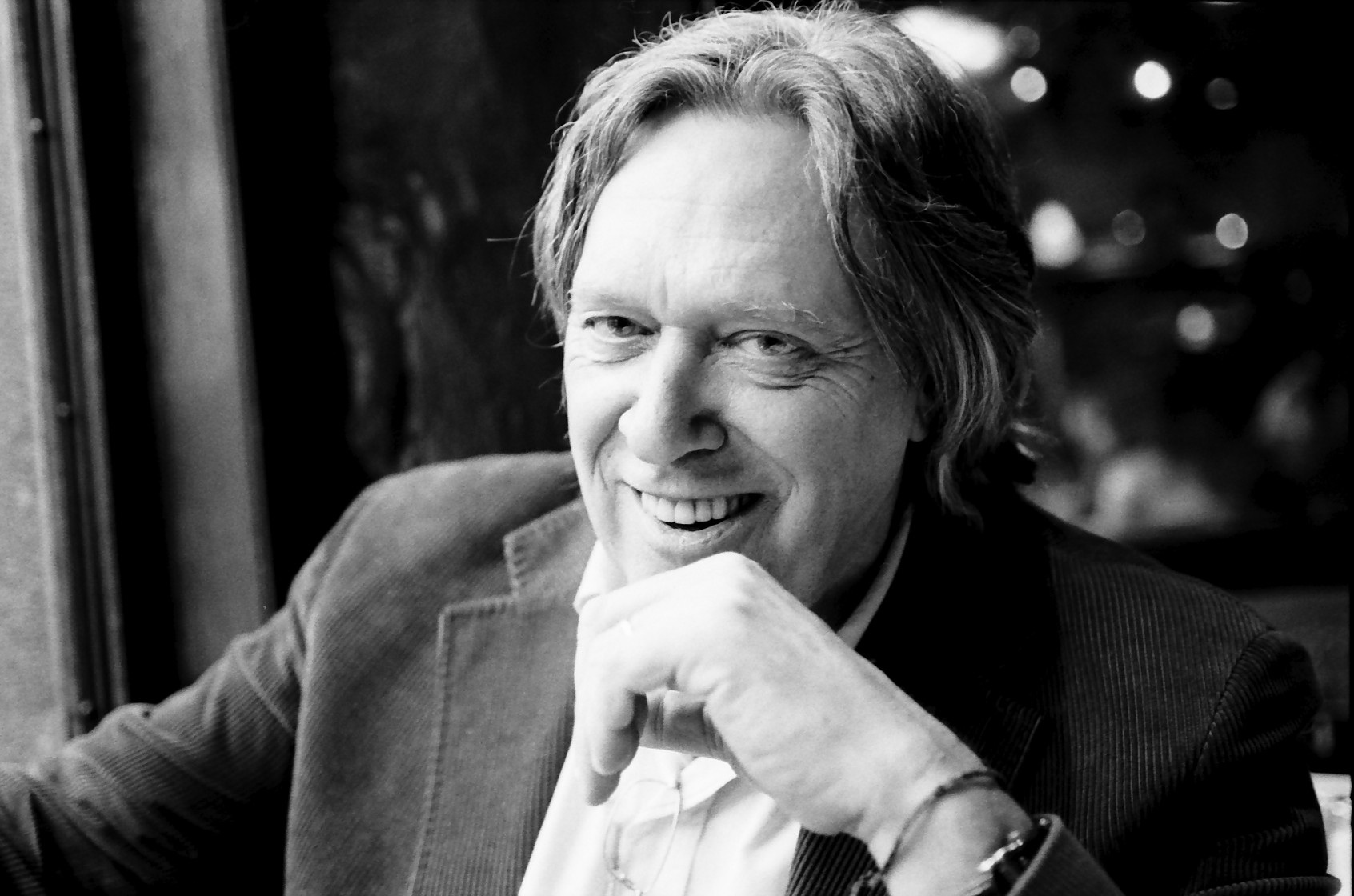
There is a particular species of Englishman who is congenitally incapable of holding down a job and therefore ends up owning several industries. Martin Miller was its purest late-twentieth-century specimen. "I've never had a job or wanted one," he said, and one believes him absolutely, because the alternative - that he simply could not have tolerated one - is written across everything he did.
He was born in Worthing on 24 November 1946, the son of an insurance agent of the old school - a man who kept his own book of customers and sold it on in lieu of a pension, and whose advice to save his son roundly ignored. Miller went to the local secondary modern, dismissed his education in later life as "crap", and offered each of his daughters two-thirds of the cost of a private schooling in cash if they would forgo it and follow his example instead. They declined. He was dyslexic, which he thought had sharpened rather than hindered him, and carried a memory for small facts that repeatedly startled the people trying to do business with him. The only time he ever worked for another man was a teenage stint as a paperboy; he did not repeat the experiment.
The dating manual had a title - Success With the Fairer Sex - and a print run: he ran it off on a Roneo duplicator and shifted between fifty and a hundred copies a week, while simultaneously breeding hamsters for sale. He was fourteen. He had no expertise, no capital and no reputation; what he had was a product, a duplicating machine and complete confidence, and the whole of the subsequent career is already there in miniature.
The Guide
He married his first wife, Elaine, when both were seventeen, went to art school, turned part-time impresario for rock concerts along the south coast, and set up as a photographer of babies and weddings. It was on a shoot involving period costumes that he fell into conversation about antiques, and the conversation became a trade. He founded The Lyle Official Antiques Review in 1970 and sold out to his partner a few years later; then, having met his second wife Judith - a would-be history teacher who had come to work for him - he launched the Miller's Antiques Price Guide series that carried his name into every dealer's shop in the country, and sold it, in time, for two million pounds.
It is difficult, now, to convey how subversive that guide was. The antiques trade ran on the assumption that the dealer knew what a thing was worth and you did not. Miller's volumes, with their photographs and brisk descriptions and actual prices, handed the customer the dealer's own knowledge in a book she could carry into the shop. It was democratic in a way nobody in Bond Street had asked for.
He lost rather more than that. In the downturn of the early eighties, his commercial property interests in the Home Counties collapsed, taking with them some twenty million by his own cheerful estimate. He appears to have treated this as weather.
Hotels, and the candles
What followed was a Kentish B&B or two, then the forty-room Chilston Park in the mid-eighties, then a publishing spree of such velocity that he would rise early, think of a title, pitch it to a house like Reed by lunchtime, and have a thirty-thousand-pound advance agreed by the end of the day - yearbooks, Christmas stocking-fillers, The Golden Rules Guide to Relationships. Having sold Chilston Park in 1998, he took the proceeds to Westbourne Grove and opened Miller's Residence, an eight-bedroom hotel whose Gothic bric-à-brac drew Marianne Faithfull and the European art crowd alike. More hotels followed, in Somerset, Herefordshire and Devon - every one of them stuffed to the picture rails with his own antiques.
He called the style maximalism. "It's the opposite of minimalism," he explained, or more simply: "When did you last see the wallpaper?"
The stuffing was not incidental. He kept buying hotels because he had to house the collection. That is not a business plan. It is a diagnosis, and a delightful one - his friend Richard Bundy said he was a natural hotelier because it let him doss in and out of other people's lives.
He could not resist candlelight, and insisted on the ivory ecclesiastical sort. When every candle in his drawing room at Eldon Lodge - a converted artist's studio in Kensington - was lit, there was barely enough oxygen left for the guests. The Notting Hill establishment became less a hotel than a party house; the Academy of Arts and Sciences, which he opened in Westbourne Grove, had a lecture theatre downstairs and a salon above it, with Simon Callow and Germaine Greer among the company.
The gin
The origin story is exactly as good as it ought to be. In a Notting Hill pub in the spring of 1998, Miller and two friends - David Bromige and Andreas Versteegh - were served three catastrophic gin and tonics: the standard weak gin of the day, tonic squirted from a gun, no ice to speak of, a limp slice of lemon. Miller turned to Bromige, who was already making vodka in Iceland, and asked why he did not make a gin.
They then spent months getting it wrong. The answer, when it came, was to distil the citrus separately from the earthier botanicals and marry the two afterwards - and to ship the spirit to Iceland to be cut with water of exceptional purity, at the height of the vodka era, which Miller cheerfully conceded was a crazy thing to be doing. Martin Miller's Gin launched in 1999, built its demand slowly, won its awards in America, and became an international brand turning over some fourteen million pounds a year by 2012 - the investment he rated, of everything he ever did, the most successful. It is now widely credited with lighting the fuse on the whole gin renaissance.
Every artisanal juniper botanical in every reclaimed-timber bar in Britain descends, at some remove, from a man being served a bad drink and taking it personally.
His mother, he liked to say, had told him she conceived him on gin and then tried to get rid of him on gin. It was, one assumes, a line invented to sell the label. It was also, unmistakably, his.
Fire
In 2009, to mark the gin's tenth birthday, he founded the Flaming Art Festival, thereby advertising two things at once. Rock stars of a certain vintage were invited to donate works for a charity auction, on one condition: any lot that failed to sell would be burned.
Consider that mechanism for a moment. It is a fundraising device, a piece of performance art, a gin advertisement and a small act of aesthetic terrorism, all at once, and it cost him nothing but the matches. There is no better single artefact of the man - unless it is his Academy of Arts and Sciences in Westbourne Grove, a lecture theatre below and a salon abov - which attracted an astonishingly eclectic roll-call of speakers: philosopher A. C. Grayling, broadcaster Clive James, journalist Rosie Boycott, chef Tom Aikens, artists Jake and Dinos Chapman, thinker Germaine Greer, actor Simon Callow, and writer, artist and professional provocateur Sebastian Horsley, of whom Miller exclaimed, "Sebastian's been before and he's a real hoot!"
His schemes grew wilder as the properties grew grander. At Glencot House in Somerset, thirteen bedrooms of Jacobean revival near the Wookey Hole caves, the lures he floated for guests included an erotic film festival, a charity tea party at which everyone would eat off a full set of Buckingham Palace silverware he had bought at auction, and a resident hermit - part-time, Sundays only. He self-published a raunchy mystery novel, The Wookey Hole Affair, whose hotelier hero, Tarmin Rimell, was an anagram of his own name and every bit as successful with women as Ian Fleming's Bond.
He had married his third wife, Ioana Beju - an artist and interior designer, an American of Transylvanian origin, whom he met on holiday in Barbados - in 2002. A light smoker who took up the habit only in middle age, he was diagnosed with oesophageal cancer a year before the end, and died on Christmas Eve 2013.
He is survived by Ioana and by five daughters from his earlier marriages - Samantha, Tanya, Natasha, Cara and Kirsty - every one of them, inevitably, an entrepreneur. That the man obsessed with candlelight and Gothic bric-à-brac should have married a Transylvanian is the sort of detail he would have claimed he arranged on purpose.
The Club's condolences go to his family. Members wishing to mark the occasion in the proper manner are directed to the bar, where the correct measure is a large one, the tonic must be fresh, and the ice must be plentiful.
He would want us to complain if it isn't.
Martin Miller, 24 November 1946 – 24 December 2013, a former Eccentric Club member.
Comments (0)
No comments yet.
Commenting is for subscribers. Sign in or subscribe to join the conversation.