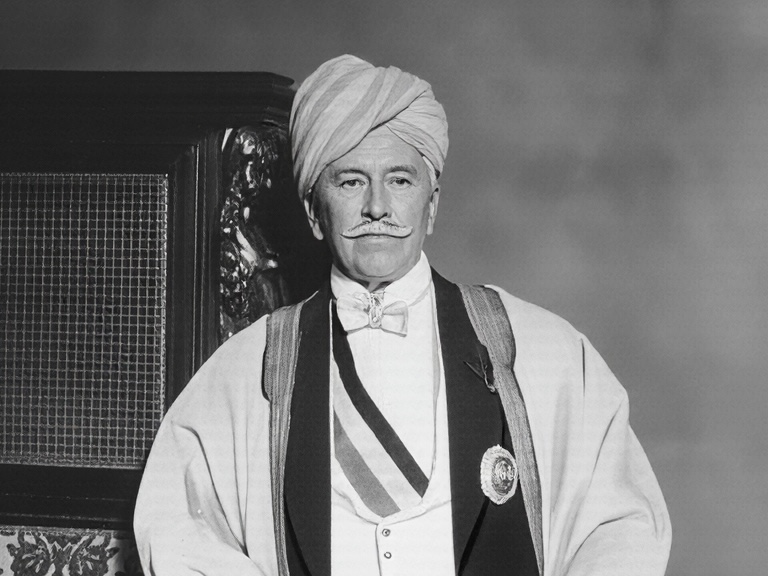
Boxer, road-builder, bankrupt, pilgrim - and, very nearly, king! Consider the curriculum vitae. Westminster and Trinity. The Middle Temple, abandoned. King's College London. A spell editing the Salisbury and Winchester Journal. A career in civil engineering, culminating in the Baramulla–Srinagar road through Kashmir and a national reputation in the protection of foreshores – a subject on which he was, apparently, the man. Co-author, in 1890, of Broad-sword and Singlestick, still the classic manual of Victorian self-defence, and sole author of Boxing, which he wrote because he was rather good at it.
And then, in 1913, his cousin died, the barony of Headley of Aghadoe came to him, and Rowland Allanson-Winn became genuinely interesting.
The convert
On 16 November 1913 he declared himself a Muslim, taking the name Shaikh Rahmatullah al-Farooq. In 1914 he founded the British Muslim Society and presided over it. He wrote A Western Awakening to Islam and Three Great Prophets of the World, became a leading light of the Woking Muslim Mission alongside Khwaja Kamal-ud-Din, and made the Hajj twice.
One should not underestimate what that cost, even a peer. This was the height of empire, and the public mood held that one could not be both British and Muslim: converts were treated as renegades to race, religion and country. Headley's rank cushioned some of the blow, but the security services took an interest in his travels abroad all the same.
He went anyway, and he went in style. Returning from the pilgrimage, he was received by King Hussein bin Ali, who gave him a gold-embroidered robe and two sections of the kiswah - the black and gold cloth that covers the Ka'ba. The larger piece he presented to Woking Mosque; the other he hung on the drawing-room wall at Twickenham. Hussein also made him a First Class knight of the Order of Al Nahda, which Headley described, with visible satisfaction, as the highest order Arabia had to give.
A section of the covering of the Ka'ba, over the fireplace, in Twickenham. There is no adequate response to that sentence except to read it twice.
Bankruptcy, and a novelist
On 11 February 1921 he married Barbara Baynton, the Australian author of Bush Studies - a woman who wrote about the outback with a bleak, gothic ferocity that the men of her literary generation could not match, and who had made a considerable fortune out of a second marriage, the stock exchange and a shrewd eye for Georgian silver. They had met, of all places, at a public meeting in Hyde Park, where both were speaking. Of course they had.
In 1922 he went bankrupt. This is a recurring difficulty with our sort of subject, and we may pass over it lightly, since worse was coming.
"The Albanians want an Englishman, a peer, and a Muslim."
In 1925, Lord Headley was offered the throne of Albania.
It is important to be clear that this actually happened. His obituary in the Australian press has the story from his own lips: a group of wealthy Albanians approached him, and he told them that if they would guarantee him £100,000 and £10,000 a year, he would consider it. They wanted, he explained, an Englishman, a peer (though his peerage was Irish), and a Muslim, and would take nobody else. Other accounts put the inducement at half a million dollars down and fifty thousand a year.
He turned it down.
Lady Headley - Barbara Baynton, who had been Barbara Lawrence of Scone, New South Wales, daughter of a carpenter, and who had spent a lifetime climbing - was outraged, and returned to Melbourne in a huff. The phrase is the Australian Dictionary of Biography's, and it is perfect. She built herself a house in Toorak, filled it with Queen Anne and Georgian pieces, grew bored, sold the lot at a profit, and sailed back to England for more. She died in Melbourne in 1929; he outlived her.
There is a whole novel in the crossing of those two wakes: the bush realist who wanted a crown, and the Irish peer who had one offered and could not be bothered.
Codford, and the end
From 1929 he lived at Ashton Gifford House, near Codford in Wiltshire - a third marriage behind him, the Albanian throne behind him, the money long gone. He died on 22 June 1935, and was buried in the Muslim section of Brookwood Cemetery.
He is not, it must be said, wholly a hero. Headley was an early denier of the Armenian genocide, defending the Ottoman government and both justifying and denying the massacres as the news reached Europe. It is a grave stain and it belongs in the record, alongside the kiswah and the boxing manual and the road through Kashmir.
Eccentric, or what?
The Eccentric Club made up its mind on 4 October 1920, when it elected him member number 2700. He had been proposed that July by Lee Murray, and - this is the detail that no biographer has ever had - the form asks for the candidate's other clubs, and Headley's answer was merely the Society of Engineers.
Not the Woking Mission. Not the boxing world. He came to Ryder Street as an engineer.
That is a small correction with a large shadow.
The man the newspapers had spent seven years treating as an apostate, a renegade and a curiosity walked into the Eccentric Club on the strength of the roads he had built in Kashmir and the sea walls he had held together, and was elected - after the conversion, after the British Muslim Society, after the first Hajj, and five years before declining a throne. A club that admits a man in 1920 and then watches him be offered a kingdom in 1925 has, one feels, earned its name.
And what a film it would make. Not the peerage, and not even the pilgrimage - but the scene in the drawing room at Twickenham, under the fragment of the Ka'ba, when the Albanians name their price and the Baron says no; and the door in the hall closing behind Barbara Baynton, who came from nothing, who wrote like a scalpel, and who could not forgive a man for declining to be a king.
Rowland George Allanson Allanson-Winn, 5th Baron Headley (19 January 1855 – 22 June 1935), also known as Shaikh Rahmatullah al-Farooq, was the Eccentric Club member No.2700.
Comments (0)
No comments yet.
Commenting is for subscribers. Sign in or subscribe to join the conversation.